

One instruction, finished files.
Obsigen reads, computes, writes and runs code — right in the browser. For every task, Obsigen GRID selects the right models, run by providers in the EEA. Your data stays on dedicated infrastructure; the model receives only what the task requires.
Finished results
Documents, spreadsheets, presentations and graphics — not just chat answers.
Dedicated tenant
Your own database and your own storage — on infrastructure assigned exclusively to you.
Verified results
Tests decide, not model agreement — in Titan mode a task’s result is verified before it reaches the user.
Obsigen GRID: several models, one verified result.
In the default Titan mode, a task goes through the full GRID: model selection, collaboration of several models, evidence-based verification and the output gate. The result reaches the user only after verification. Simple questions such as “hello” are answered straight away by a single model.
Questions, short tasks and work on files.
Harder reasoning and long documents, with basic GRID orchestration.
Reports, analyses and code with tests — full GRID orchestration and a plan preview.
One system. Three interfaces.
The same Obsigen, where your team already works.
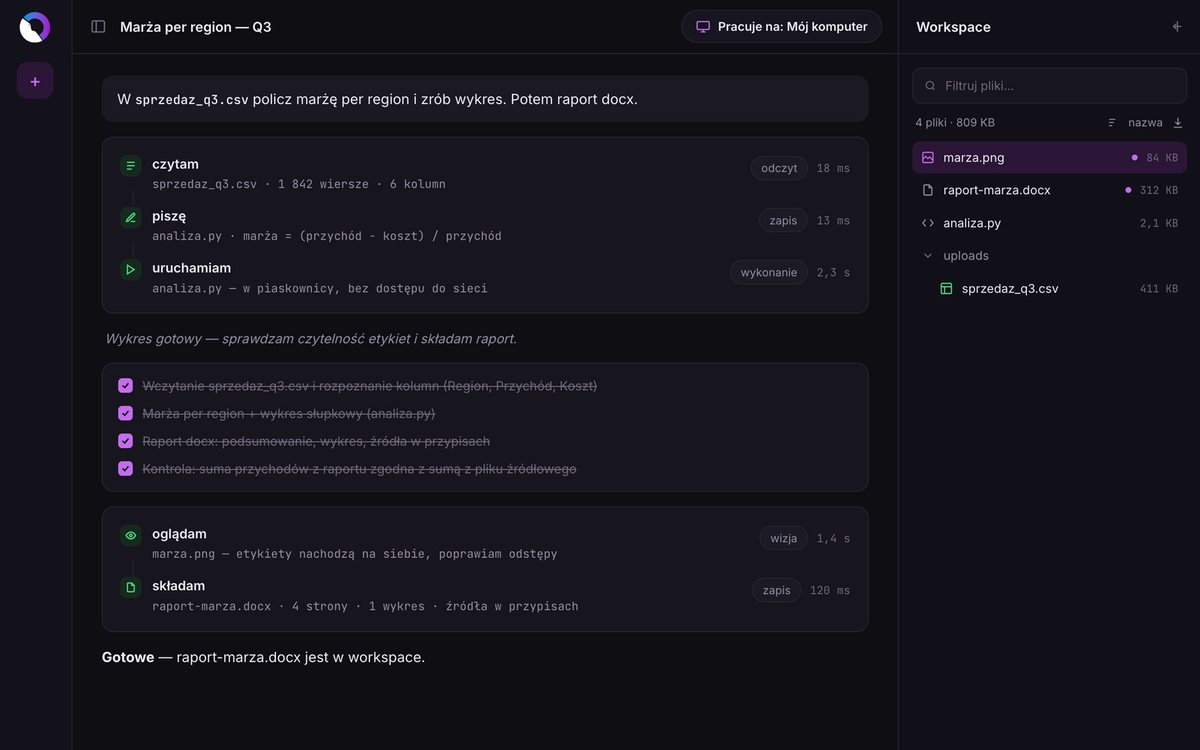
Obsigen in the browser
A web application for working with company documents and data. Nothing to install. Reads files, calculates in spreadsheets, writes documents and decks; finished files land in the Workspace panel.
 Tax-ID validation in checkout
Obsigen Forge for VS Code
A coding agent in VS Code — from spec to tested code. Syntax checked after every save; commands are classified before they run: reads without asking, writes and deletions with consent, the rest blocked.
Obsigen Runtime
An agent on the workstation, no IDE. It works on local files and saves results to the folder you choose; consent for commands comes in a native system dialog. macOS and Debian; on Windows in preparation.
What we're building next.
The Obsigen team works on the product every day. The next release of GRID is already in the works.
Model selection and verification are the first layer of GRID. We are developing the next one - the Artifact GRID release - as a shared, verifiable state of knowledge about the task: models add hypotheses, artifacts and test results to it through references, without passing content to one another. Every conclusion has a provenance, and verification decides what is true. Details will be published on launch day.
Visualization · artifact codes are illustrative
Deployment models
Data always on dedicated infrastructure. You can change the model later.
Managed Cloud
We deploy and maintain Obsigen on dedicated OVHcloud infrastructure in the EEA. One contract: infrastructure, deployment and maintenance.
Best for the fastest start, with no IT effort.
Self-hosted
We install and maintain Obsigen in your environment. Hosting, access and security policies stay under your control.
Best for organizations with their own IT and hosting.
On-premise · on request
Data, GRID and models in your own data center, with no connections to external model providers.
Best for regulated sectors and highly sensitive data.
How Visera deploys Obsigen
Obsigen is our product. We deploy it, connect it to your documents and systems, and keep it running.
Goals, data, systems and constraints — and the deployment model that fits.
Your dedicated tenant, access for the team and integrations agreed before we start.
Working sessions on your own documents and processes, not on generic examples.
Updates and support from the team that builds the product.
See Obsigen on your own example
A 45-minute online demo on a document, spreadsheet or process you bring.