

Artifact GRID is now running in our tests
The next layer of Obsigen GRID: models don't pass content to one another — they build a shared, verifiable state of knowledge about the task. Here's one test run, step by step.
We design, build and operate secure, AI-ready platforms across the EEA — so your teams can ship product instead of firefighting compliance.
Audits, penetration testing, incident response — defended with the same AI tools attackers use.
Learn more about CybersecuritySecure your LLM agents, RAG pipelines
and AI workflows — with the EU AI Act in scope.
RAG, agents, evals — automation that actually ships and stays in production.
Learn more about Applied AIThe European AI agent we build —
connected to your ERP, CRM and e-commerce.
Modern commerce platforms with security designed in and AI doing real work — under your brand.
Learn more about E-commerceCustom web, mobile and backend systems — engineered for production, not slideware.
Learn more about Apps & Platforms
Custom web, mobile and backend applications — engineered for production, not slide decks. Integrated with the ERP, CRM, e-commerce and identity you already use, and operated by the same team that built them.
Modern adversaries use AI to find weaknesses faster — phishing kits, automated reconnaissance, prompt-injection chains. We use the same modern AI tooling on the right side of the fence — combined with the classical security engineering you already expect.
For every task, Obsigen GRID selects the right models, run by providers in the EEA; in the default Titan mode the result is verified before it reaches you. Data stays on dedicated infrastructure, with Zero Data Retention.
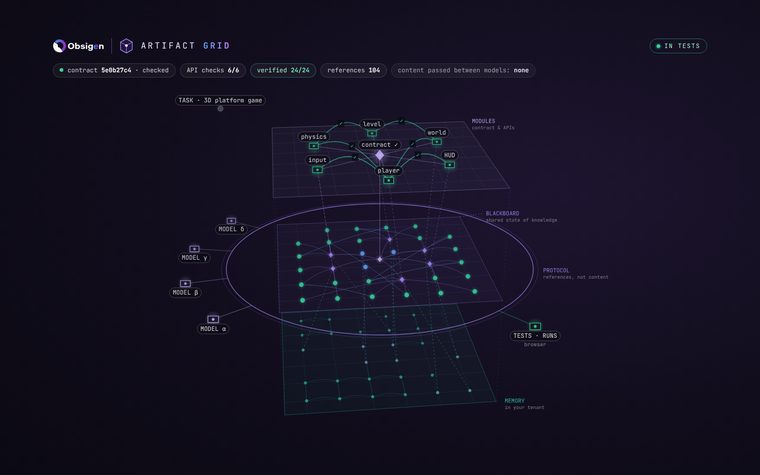
Artifact GRID, the next layer of Obsigen GRID, is now running in our internal tests. Models don't pass content to one another: through a protocol built on references they fill a shared blackboard — a verifiable state of knowledge about the task, backed by memory in your tenant — and verification decides what is true.
Artifact GRID in three layers. Top: the contract and six modules of a 3D platform game, connected by APIs that are checked for compatibility. Middle: the blackboard, a shared state of knowledge about the task, where every artifact, hypothesis and test result lands as a reference. Bottom: memory in the customer's tenant. Around the blackboard runs the communication protocol: models α to δ and the test runner exchange references, not content. In this run, three earlier artifacts are recalled from memory, all six API checks pass, a browser test falsifies one player conclusion and the two conclusions built on it are retracted; after a fix and a re-run they are verified again, and 24 conclusions with their lineage are stored back in memory.
Visualization of an internal test run · sample task: a 3D platform game · codes are illustrative
28 concepts in plain language — from prompts and RAG to agents, prompt injection and the EU AI Act — each with what can go wrong and how to secure it.
Open the AI CompassField notes on EU AI Act, AI Security, Obsigen and engineering for European companies.
From cloud and containers to frameworks and commerce platforms — picked for performance, reliability and EU jurisdiction.


Tell us the goal in two sentences. We'll come back with the smallest engagement that gives you a defensible answer.
Get in touchOpen an SLA-backed support request — incidents, change requests, audit help. We answer fast.
Customer Care